
How can we help you?
Our address is Unit A9, 5350 Mainway. Burlington, ON. L7L 6A4.
Visit our Training Centre page for more details.
A short 5 minute drive from Appleby GO Station, trainees can easily take public transit to the Training Centre.
We are easily accessible using public transit via GO Transit. Our training staff takes public transit and can give you a ride to the training centre. Just shoot us an e-mail.
We understand that there are instances where it may not be possible for you to attend a course you’ve registered for, and for that reason we’ve adopted a policy that can help with that.
A 5% administrative fee will be deducted for all refunds.
We are happy to refund deposits and course fees for a cancellation made up to 30 days prior to the start date of course.
Cancellations made 29 days or less could lead to non-refund of deposit if RAM is unable to fill the reserved spot.
Cancellations made 7 days prior to the course will lead to a loss of deposit.
Full payment is due on the first day of course, unfortunately if you are unable to continue the course after the first day the full cost of the course is non-refundable at that point.
Shoot us a message! We will look into opening another course or depending on several factors, potentially changing the dates to accommodate you, especially if you are a contractor or are looking at registering multiple people. Also, as courses get fully booked, we regularly add more.
Keep coming back to the Course Dates and Registration page as new courses pop up.
You need to take this training if you work on a construction project and are required to use any of the following methods of fall protection:
- travel restraint system
- fall restricting system
- fall arrest system
- safety net
- work belt
- safety belt
Remember, this training requirement is in addition to the equipment-specific training
Exposed to falling more than 3 metres or onto anything hazardous, such as paths for equipment, operating machinery, water or liquids, dangerous substances or objects as well as through openings on a work surface.
You will leave the training centre with records of training, both as a wall certificate and card.
Working at heights training is valid for 3 years after the successful completion of an approved program. After 3 years, workers need to successfully complete a refresher program to keep their training valid for another 3 years.
To be eligible for refresher training, workers must have previously successfully completed both modules of an approved working at heights training program.
You can verify if you can register only for the refresher course using the MLITSD eligibility checker tool.
Full course starts at 8am and finishes at 4pm. Lunch break is scheduled around noon.
Refresher starts at 12:45pm and finishes at 4pm.
Rope Access is a tested and standardized set of skills that adapted climbing, mountaineering and caving knowledge and brought it to our evermore industrial and vertical cities and landscapes.
In a nutshell, independently certified rope access technicians, overseen by qualified and experienced supervisors deploy a unique 2 rope system to reach difficult or otherwise impossible to reach areas in order to perform work with minimal amount of setup and disruption.
Safety is maximized by complying with strict guidelines set by Rope Access associations, international standards, certification requirements and local legislation.
Rope Access teams are self-reliant: the system comprises training, planning, access, work, supervision and rescue systems.
Yes, both IRATA and SPRAT certifications are internationally recognized. They are the industry standards for rope access work globally, ensuring that technicians can work safely in different sectors like oil and gas, construction, wind energy, city maintenance, window cleaning, towers, among others
IRATA requires a minimum of 4 days of training + 1 day of independent Assessment.
Based on our training experience, RAM’s training program has been crafted as a 5 day training course in order to give candidates one extra day of learning and practicing before Assessment / Evaluation day. That extra day has increased the candidates confidence and enabled us to maintain a very high passing rate.
IRATA stands for Industrial Rope Access Trade Association.
IRATA rope access certifications are accepted internationally. Often required by multinational oil companies as the only Rope Access certification they recognize, IRATA’s strengths include in-depth code of practices, highly structured training and strong integration with many health and safety regulators around the world. Advancement between levels requires at least 1 year and 1000 hours of verifiable, logged rope access experience.
SPRAT stands for Society of Professional Rope Access Technicians.
SPRAT is a USA-based certification and is widely accepted in Canada, generally everywhere else other than Oil and Gas, even though it is largely accepted in the US in all sectors including Oil and Gas, especially in the Gulf of Mexico and surrounding areas. In Canada, it is particularly common in commercial maintenance, rescue teams and the wind energy industry. It’s a flexible association that allows technicians to log hours and upgrade easier than IRATA, which allows access to higher wages in industries that accept SPRAT. Advancement between levels require 6 months and 500 hours of logged and verifiable rope experience
For certification requirements, click here:
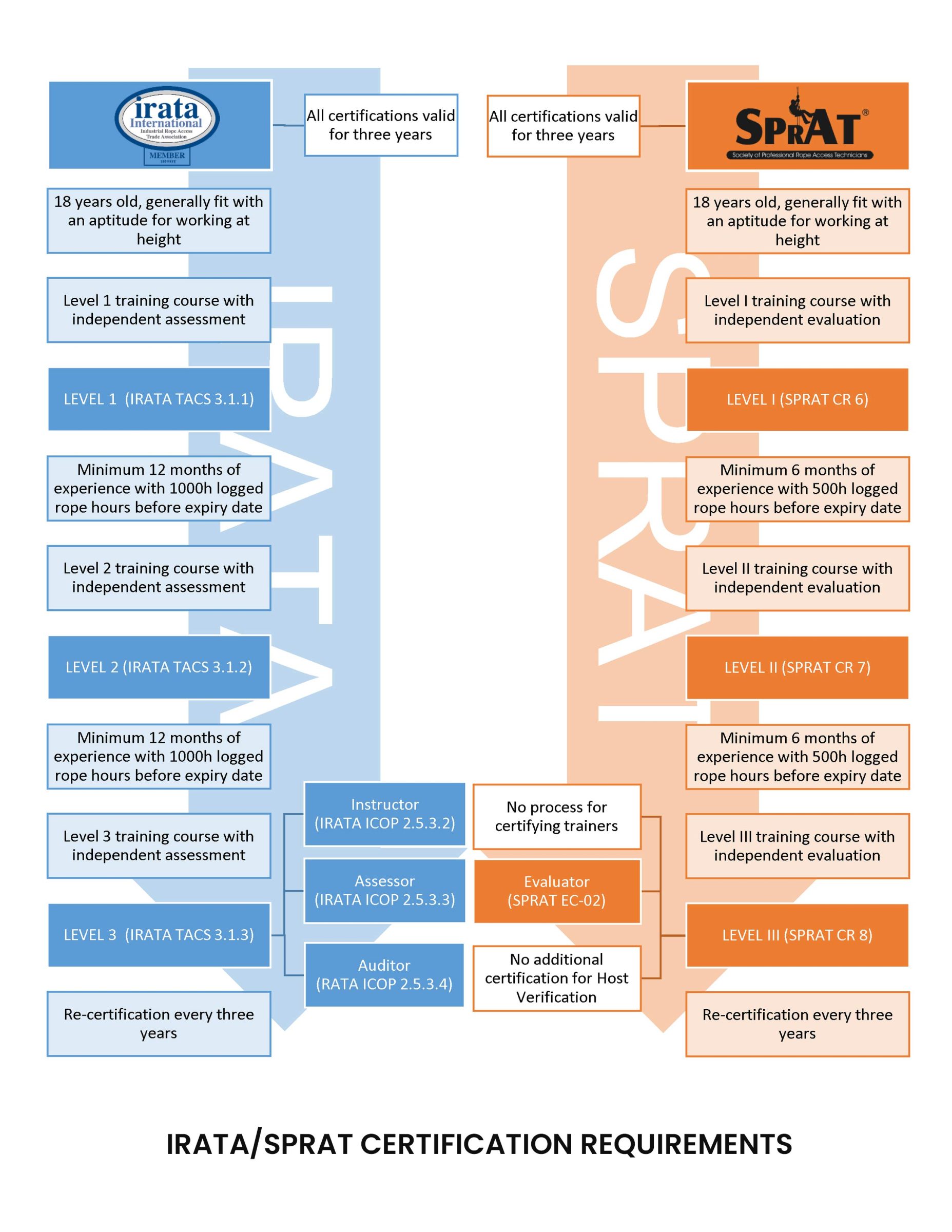
If you are new to the rope access industry, yes, you need to start at Level 1 where you will learn all the basics. If you are already certified, both organizations have established processes for converting to one another. Both organizations charge fees and require applications to be processed in advance. Contact us for more information or assistance.
IRATA’s process (Procedures for IRATA Certification) is available for currently certified and valid SPRAT technicians to convert to IRATA.
SPRAT maintains a Direct Entry Program in which IRATA technicians are eligible to direct entry into Level 2 or Level 3.
In order to maintain the highest level of safety, training companies are not allowed to test their own candidates. That is a way to eliminate any conflict of interest that might put safety behind corporate interest in allowing candidates that are not yet ready into the field. For that reason, RAM brings in an independent third-party to test the ability of candidates and assess if they match the safety requirements to become Rope Access technicians.
The test happens on the last day of the course, and depending on the level of
candidates, can take from a few hours to the entire day.
IRATA calls this test an Assessment, and the third-party an Assessor.
SPRAT calls it an Evaluation, and the third-party an Evaluator.
When you pass your IRATA Assessment, you will leave with a copy of your attainment. Once the paperwork is processed, your certification will be issued and you will be immediately eligible for work. Certifications are usually processed in a couple of days by IRATA in England and certificates are mailed to your address. This may take about 3 or 4 weeks.
When you pass your SPRAT Evaluation you will be provided immediate access to your digital certificate through the SPRAT technician portal. A certificate will be made by SPRAT in the US and mailed to your address. This may also take about 3 or 4 weeks.
If you fail your exam, you will not be certified and will have to try again. Good news is we will not charge you for a whole new course.
RAM charges a new deposit flat rate (currently $1000) in case of a failed Assessment / Evaluation should they register for a new course within 60 days of their first Assessment/Evaluation. This is designed to cover our own costs. We will do our best to fit a failed candidate in upcoming course dates.
The independent examination is designed to verify the candidates knowledge and skills required for their level of certification. After an introductory briefing and paperwork, candidates competence will have their competence verified in equipment knowledge and use, rigging and system construction, basic rope skills as well as rescue capabilities.
The intent is to allow the candidates to demonstrate their training and retention of knowledge by demonstrating proficiency in the course content to an independent verifier, who is there simply to ascertain that learning outcomes have been met.
All candidates start their exam with a passing grade and get points deducted as they make mistakes (known as discrepancies), which are classified as (minor) discrepancies and/or outright fail (major discrepancy).
The Candidate’s Guide to IRATA Assessment explains the IRATA Assessment process in detail.
SPRAT’s Rope Access Evaluation Guidelines provides the information and resources used in rope access evaluations.
Your rope access certification is valid for three years.
You can. If you have any questions, get in touch with us.
If you are an expired IRATA technician, consult Procedures for IRATA Certification for direction.
SPRAT allows technicians to upgrade even while expired, provided the hours were accrued while valid.
For rope access training, candidates must be at least 18 years old, have a valid piece of photo I.D., be physically and mentally fit and have a general inclination for working at heights.
Level 2 and 3 candidates must provide proof of valid rope access hours in order to advance levels.
Rope Access work is a physically demanding, strenuous activity that demands technicians to be self-reliant, responsible and attentive while working in physically demanding conditions accessing difficult to reach spots.
IRATA and SPRAT require candidates to learn an array of technical and theoretical skills and knowledge. Candidates will learn and practice for 8 hours a day, 5 days straight, after which they will be assessed by an independent third-party in order to uphold the highest level of safety and quality.
It is recommended to see a doctor for a physical check-up prior to registering or starting the course. As recommended by IRATA, candidates with certain conditions should refrain from taking a Rope Access training, including, but not limited to:
“prescribed medication that may impair physical and/or mental function; alcohol or drug dependence; diabetes, high or low blood sugar; high or low blood pressure; epilepsy, fits or periods of unconsciousness, e.g. blackouts; vertigo, giddiness or difficulty with balance; heart disease or chest pain; impaired limb function; musculoskeletal issues, e.g. back pain; psychiatric illness; fear of heights; sensory impairment, e.g. blind, deaf.”
RAM provides all rope access equipment necessary for training, including helmets and Personal Protective Equipment (PPE). In order to comply with Rope Access associations requirements, all our equipment meets strict inspection and tracking guidelines, so candidates are not allowed to bring any personal equipment.
Candidates are encouraged to bring comfortable clothing and no open-toe footwear.
As a training facility, we have a small kitchen with a microwave, fridge and coffee maker, which candidates are welcomed to use. Feel free to bring your own food or enjoy a multitude of food options within a short drive.
You can Register directly for rope access training and pay through our website under the Course Dates and Registration section. Simply pick a course date, click the Register Now button and fill out the form to complete your registration.
The payment system has been set-up as a way to protect both RAM and the candidate from cancellations, last minute changes and unforeseen circumstances. If you do not have a credit card, get in touch with us and we can send you an invoice or discuss other payment options.
Total course prices are $2200 for single certification (IRATA or SPRAT) or $2600 for dual certification (IRATA + SPRAT). You may pay in full or a $1000 +HST deposit to guarantee your spot. The remainder of the payment is due at the beginning of course. Your deposit will be deducted from the total amount.
The cost of the course includes tuition, use of all rope access equipment as well as certification fees
We will send an invoice for the remaining balance just before the start of the course. Payment is due at the start of the course and it can be made with a credit card, debit card, cash, e-transfer or cheque.
We take pride in providing all trainees with a safe space for their training and development. There is absolutely zero tolerance for discrimination of any nature (sex, gender, race, religion, ethnicity, etc). If you are disrespectful you will be removed from the course.
In addition, please see IRATA’s Technician Code of Conduct and SPRAT’s Candidate Preparation Checklist.
The independent examiner (IRATA Assessor / SPRAT Evaluator) can only determine the competence of 8 candidates at once, which typically establishes the maximum class size of 8 candidates per course. Sometimes we open courses up to 12 registrations with two days of examination to ensure ratios are met.
Our maximum ratio is one Instructor to six candidates (6:1). For the majority of courses we provide two instructors for a maximum of 8 candidates (4:1). This ensures close supervision, personalized attention and quality instruction.
Yes, all IRATA training courses are open for IRATA Level 1, IRATA Level 2 and IRATA Level 3 candidates. All SPRAT training courses are open for SPRAT Level 1, SPRAT Level 2 and SPRAT Level 3 candidates.